

The world bestseller “Thinking, Fast and Slow” by Daniel Kahneman explores two systems of thought:
- System 1 (fast, instinctive, and emotional)
- System 2 (slow, deliberate, and logical)
We will look at System 2. It is responsible for complex judgments and decisions requiring effort and concentration. It addresses how this deliberate thought process can be influenced by biases and overconfidence, often leading to errors in decision-making.
But what does it take to optimally operate System 2?
A popular system for long-term decision-making is a classic pro and con list about the outcomes of the decision. But somehow, even though we weighted the arguments appropriately and finished the list with a clear result, we struggle with a decision. But why is that?
You can think of your thoughts as data points gained by experiments conducted in your brain. If you decide something based on a one time written down pro and con list, it is if you announce a scientific discovery based on the results of one experiment. So, what to do instead? As it is done in research; run the same “experiment”, the same thoughts multiple times. Run your same pro and con and analyse the outcome. This is nothing else than replicates and experiments under different conditions. And if your input stream of thoughts are the data points, see yourself as the scientist, as the observer who is recording all types and variants of thoughts that come in under different conditions. In the end, you want to average over all collected thoughts tackling a particular topic and take the best decision.

Some thoughts might come in when you are stressed or tired, others when you are active and happy. Others come in when you had a though day at work, others when you just finished a workout. Any big decision should not be based on any of these single events. Same as no big scientific discovery was based on just one experiment!
As replicates are hard to accomplish for thoughts (how can you ensure that you are in the exact same state as when you had a particular thought the last time?), make sure you test any potential decision you draw from thoughts at least under different conditions. Are you coming to the same conclusion when you think about it the 2nd, 3rd, 5th or 10th time?
Let us look at an example: Maria does not know what to study. She likes literature but is also good with numbers. So apart from that she also takes economy into consideration. On emotional and happy days, she is more in favour to study literature, her true passion. On days where she struggles and is a bit moody, she prefers economy, since it seems the safer option. A pro and con list would not help much because she is having problems weighing the single arguments. A solution can be to run the thoughts multiple times. She enters an active appointment into her calendar to think about it several times per week to have a broad sample over a month. After each thinking process, which should be time-limited, she writes down what she concludes, including all possible variables. After a month, she can analyse the data, average over the data points and take a considerate decision.
Another typical example that everybody knows is when we shop for groceries while hungry. Our condition of being hungry affects very much our purchasing decisions. As a result, we often end up leaving the supermarket with much more food than if we weren’t hungry. The solution, of course, is to prepare a shopping list in advance when we’re not hungry. And stick to it.

So does this help to take the best decision? Yes! Is it guaranteed? Of course not. But it makes sure that eventual noise that lays on your thinking process, based on your condition, is less influencing the decision. And here time is the limiting factor; the amount of time you invest in a decision should be correlated with the importance. Deciding what are you going to study should take significantly longer than your plans on the weekend. Where does this come from? Well, It is naturally correlated with the amount of noise you can tolerate for a decision. A decision of low importance can be made fast, because you don’t care if the decision is precise or not. For decisions of high importance, you want high precision, i. e. no noise. Our current state always influences a decision. How much noise can we tolerate?
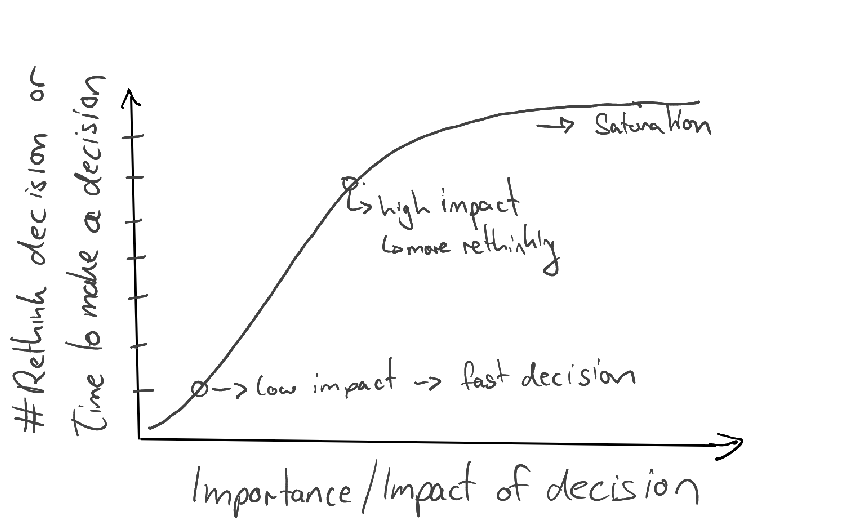
But aren’t we doing this already? Of course, we all can spend months on decision-making. However, structuring decision-making helps to avoid stepping into traps of taking inconsiderate decisions in unfortunate moments. And your thoughts are nothing else than a constant stream of data that is influenced by your condition.
Plus being aware and understanding the mechanism always helps.
Some practical advices at the end:
- Never have difficult conversations with your boss, your partner or friends when you are tired or stressed. The outcome might deviate tremendously from what your awake and relaxed self-wanted.
- When you take a decision, be actively aware or write down in which condition you were. Later it is easier to track down why you took a certain decision and makes you more confident to take it back.
- Be as quantitative as possible. Of course, a personal condition is way more qualitative than quantitative. But already noting “Today, I am 8/10 happy” instead of “Today, I am happy” helps to draw conclusions and back-engineer your actions!
Especially the last point is fascinating; Not only about our personal condition, but we should generally observe outcomes that are followed by inputs. This can be everything regarding ourselves; how does our body react on a certain nutrition? How do our muscles grow on certain exercises? Which conditions avoid us from getting sick? Some of the answers are very general and true for each human being, some are very personal. But even if had written down all data points, could we have predicted all outcomes? Clearly not. There is too much randomness included. And this is good.