
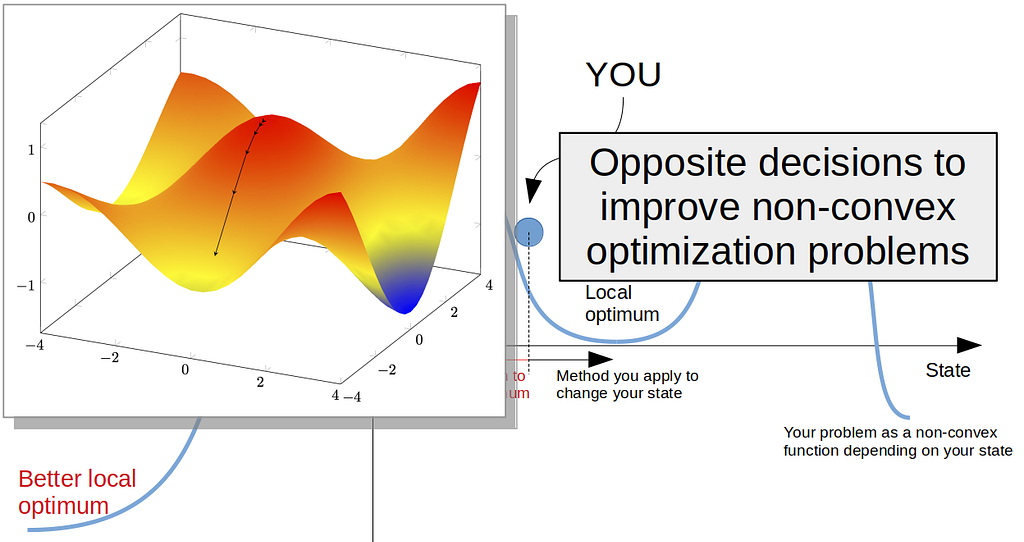
In my personal environment, I see many people (including myself) who constantly find themselves captured in their ineffective patterns. They face a problem and try to solve it, and if it doesn’t work out, they try to apply the same method again or even harder in some way. And if the problem gets solved, they usually run into a similar problem again because their overlaying pattern has not changed. They apply the same problem-solving method and eventually resolve it — only to run into the same situation again. The same applies to groups of friends, businesses, or even whole societies where the people decide (as a group) to run into equal conventions again.
In many cases, the solution is to do a random step or apply the exact opposite procedure of what you have usually done. The more counter-intuitive it appears, the better!
Breaking patterns
Not convinced? I’ll give you some examples:
- Business: Many software companies in the 2000s had a business model where they would program software and sell it to people. What happened? People started to copy their product and share it with others illegally. Their reaction? Even more onerous restrictions and encryption of their software packages. However, it was pretty hard to track down and prevent the problem, which would usually come up with their next software solution. Google approached the market in the exact opposite way. They made their apps publicly available for everyone. Gmail, Gdrive, Gsheets, etc. were excellent software solutions for free. As a result, entirely new markets opened up for them, they gained lots of customers, collected lots of data, and became one of the most, if not THE most successful (software) company in the world.
- Private: A friend of mine is more of an organized person. She prefers to set a specific time to meet friends and has precise schedules. Naturally, she always struggles with friends of hers who tend to plan nothing, meet up casually and cancel a meeting on short notice. Her solution was to plan even more with these people, double-check to make sure they’d show up, and make concrete plans. If this didn’t work out, she would strengthen this behavior because that’s how she always behaved, and she thought she could fixate on those casual friends. Her strategy failed in most of the cases. How could she get out of this pattern? At one point, she started to treat those people how they wanted to be treated, meaning that if she set up a meeting with them, she would still be open to alternative things, casually make other plans on short notice, or simply would not care too much if she was late. So instead of being even pickier with those people, she did the exact opposite by being super casual with those people. Of course, she does it in an authentic, natural way; otherwise, it would be just childish. In the end, genially, these casual people do not care if someone cancel’s on them plus she feels a lot better with their change of behavior. She could get out of her overlaying pattern.
- Private: Many people tend to be rather quiet and reserved towards people they think they are not liked by. However, these people sense this reticence and are in turn also reticent, which again creates in oneself the feeling of rejection. This is a small vicious circle which can not be escaped from by keeping the same behavior. The solution can be to act the opposite way, that is, to be extra open and friendly with these people to offer them a positive framework even though it seems rather counter-intuitive.
- Inside a company: Let us look at some very average company somewhere on the globe. The company’s policy says the employees have to work from 9 to 5 every day. After a while the company suspects some of their employees to come in late and/or go early and not work the full hours as said in their contracts. As a result, the company wants to force their employees to comply with their hours by installing time tracking devices where people have to check in and check out. What happens next? People start with avoidance behavior where they would hide somewhere or stay longer in the bathroom than necessary (these things happen!!!!) to avoid working 8 hours a day. The company becomes even more restricted and introduces efficiency measures that provoke new employee avoidance methods. What could be the opposite here? Let it go and give your employees as much freedom as possible, flexible hours, benefits, and trust. They will start to identify themselves with their company and work extra time voluntarily, which is beneficial for the company’s outcome. Instead of trying more of what was previously done, the opposite or even a random thing could lead to a better optimum! Needless to say, this method does not work for all types of companies, but one should consider it at least.
There are many more examples. In private as well as in corporate, on small as well as on big scales! If you got some example or even a pattern in your personal life you want to break, let me know in the comments. Try to think about what is the opposite of what you’re currently doing wrong. You can reach everything, but sometimes you have to drop beliefs and start moving in different directions.
Analogy to non-convex optimization
But actually, why is this so messed up, and where does it come from? Here, I’d like to start with an analogy to non-convex optimization. A non-convex optimization problem has the fundamental property of possibly having more than one optimum. However, most optimization algorithms are usually very good at identifying only one specific local optima.
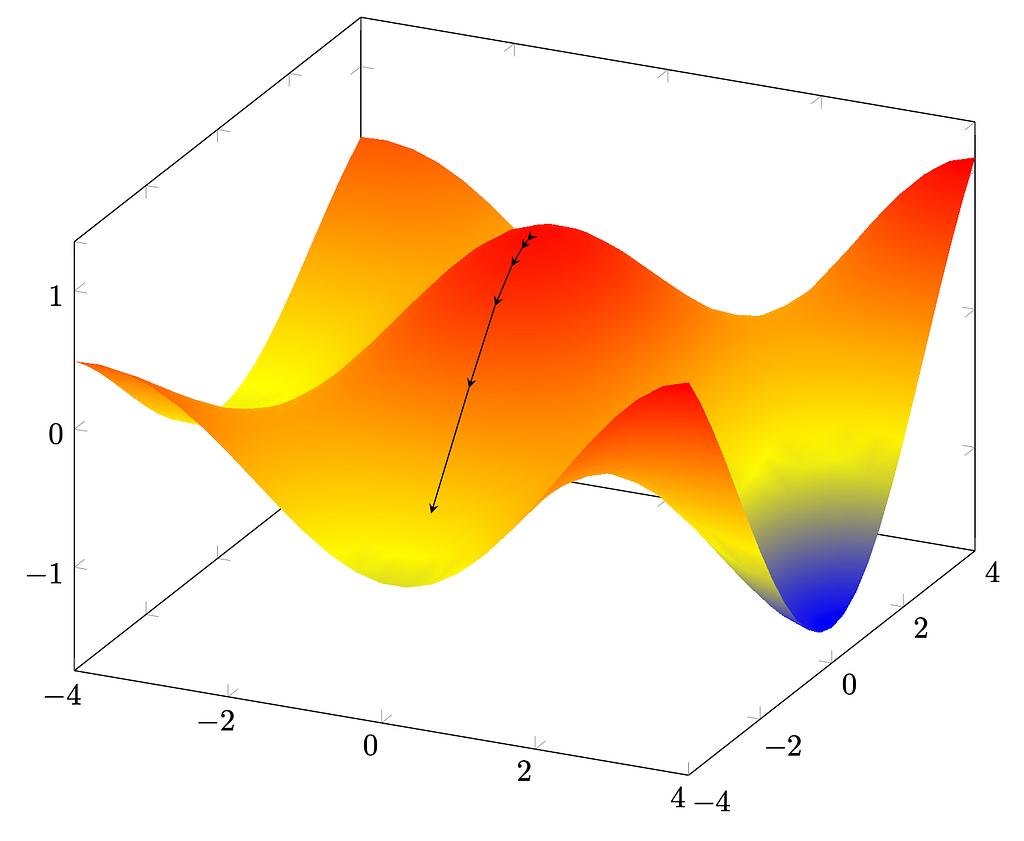
You start at one point, look at your local environment and walk towards the most considerable descent, as you were standing on some hill trying to find the valley. You would descend. However, a non-convex optimization problem can have an even lower valley (minimum) behind the hill you’re descending from, so you would never reach this lower valley. The solution is to step against the odds, act against your intuition and do the exact opposite of what you usually do! The same technique is applied in various optimization algorithms, i. e., in simulated annealing, where worse states are accepted with a certain probability throughout the procedure, or general methods with random seed points.
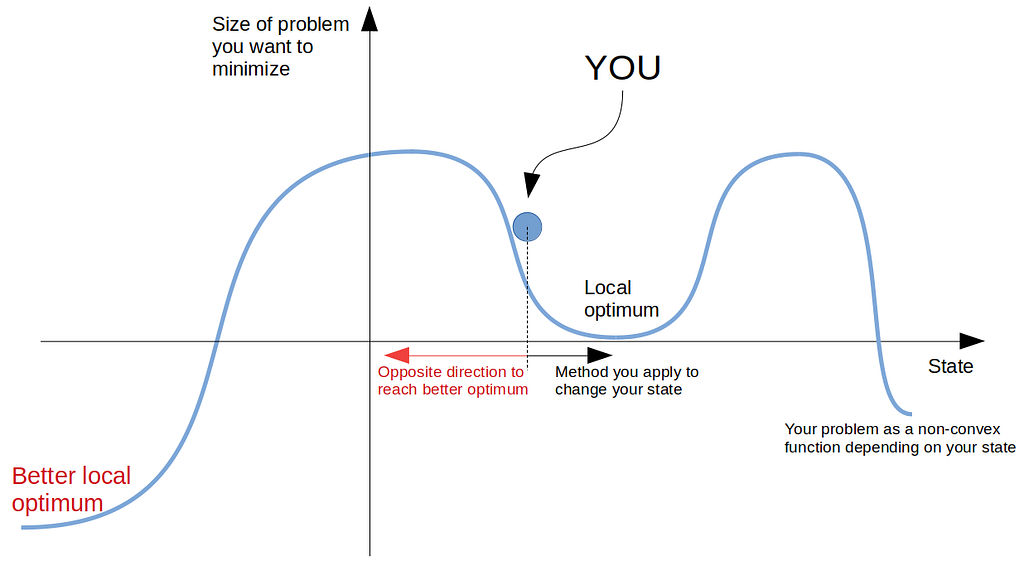
Here, we assume the abstract “state” variable as a continuous and ordered dimension which might not always be the case in the real world, but helps us in this simplified model. The direction you go is the method you apply to change your state. By going in a different (or opposite/random) direction, you worsen your situation in the first place. However, when you reach a hill, other more profound valleys are visible. Achieving a better local optimum comes with a temporary worse situation from where you can head to better solutions. It helps to zoom out and see the bigger picture. This technique can be especially valuable for beliefs you had all your life. Question them and try to find out what happens if you act against them.
Life as a non-convex multivariate function
In a more advanced approach, you can also look at your entire life as a multivariate non-convex function with multivariate targets (problems). Changing the state of one feature to optimize a particular problem can worsen another problem. For instance, if you want to be able to lift heavy weights, you train for it to reach an optimal state, e. g., very strong muscles. At the same time, you worsen your pace, which brings you up the hill regarding this target variable. It can also mean that the size of one target variable depends on the state of several features, which includes changing more than one feature in combination with another feature can cause different, unexpected outcomes again. Because of all these interaction effects of infinite large feature space for infinite many target variables, doing counter-intuitive things or random steps might lead to better local optima. The system is just too complex for even the best intuition and therefore applying only gradient descent methods is not sufficient. In a future article, I will describe my approach to a non-convex multivariate optimization problem of life more technical, including mathematical notation to clarify the analogy to the real world.
In conclusion, it basically describes the habit of stepping out of your comfort zone, doing something novel or at least, looking at challenges from different angles. This can be particularly game-changing for situations you have run into all your life! As always, please do not hesitate to comment or contact me in case of any errors or suggestions, I would be happy to get into discussion.